
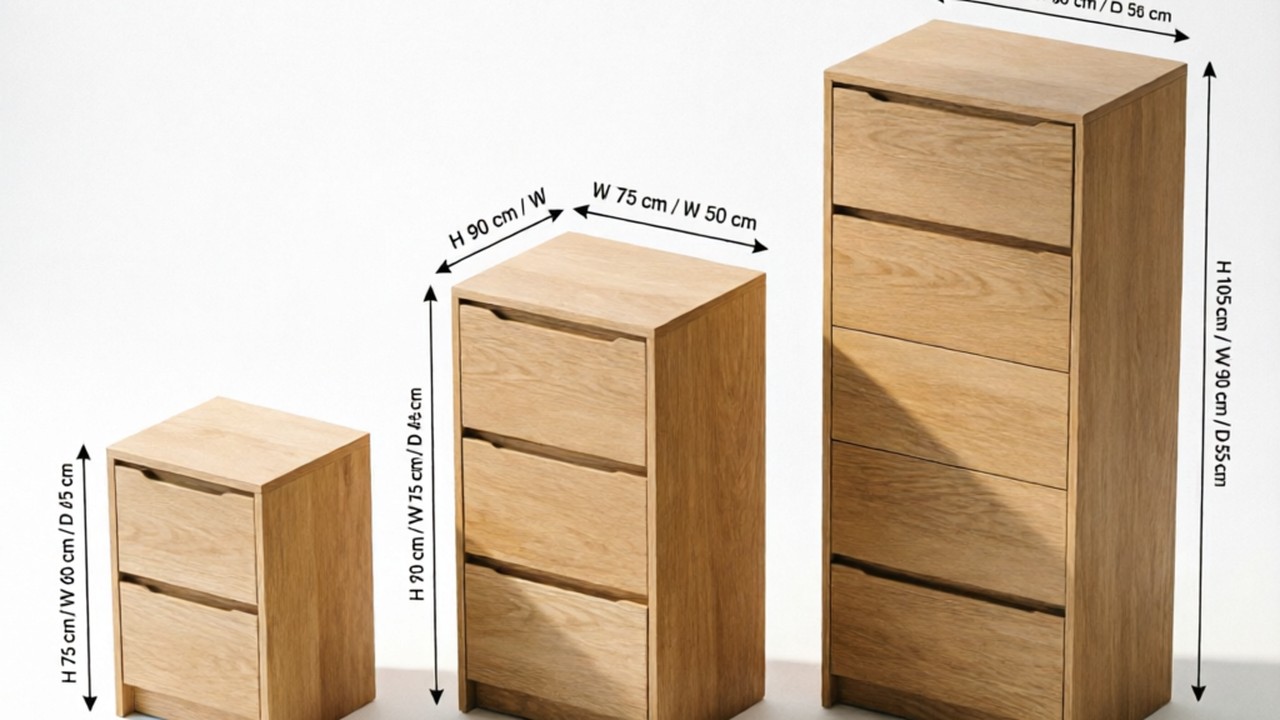
Buying a dresser online is easy. Getting the size right so it actually fits your room, your clothes, and your daily routine — that’s the hard part.
Dresser dimensions aren’t random. They follow patterns based on drawer count, furniture type, and the room sizes they’re designed for. A 3-drawer dresser has a typical footprint. A 12-drawer double dresser has a much larger one. Once you know the standard sizes, matching a dresser to your space becomes straightforward.
This guide covers every dimension that matters — width, height, depth, drawer interiors, and clearance requirements. You’ll also find a comparison table of common dresser sizes, a room-by-room sizing guide, and detailed instructions for measuring your space.
Understanding Dresser Dimensions: Width, Height, and Depth
Every dresser has three dimensions that determine where it fits and what it can store. Each one serves a different purpose.
Width determines how much wall space the dresser covers. It’s the first dimension most people check because it dictates whether the dresser fits between existing furniture, windows, and doorways. Width also directly correlates with drawer count — wider dressers have more drawers or wider drawers.
Height affects both visual proportion and usability. A dresser that’s too tall blocks sight lines and feels imposing in a small room. A dresser that’s too short feels out of scale against a tall bed frame or headboard. Height also determines whether you can mount a mirror above it while keeping the mirror at useful eye level.
Depth is the dimension most buyers overlook — and the one that causes the most problems after delivery. A dresser that’s too deep eats into walking space and can block doorways or hit the bed frame when drawers are open. Depth also determines what size items fit inside the drawers. A 14-inch deep dresser handles folded clothing fine. A 10-inch deep one forces you to fold everything smaller.
All three dimensions work together. A dresser that’s perfect in width but too deep for your room still won’t work. For a complete set of size-specific recommendations, see our best dressers roundup.
Standard Dresser Widths by Drawer Count
Width is the most variable dimension across dresser types. The number of drawers gives you a reliable estimate of how wide a dresser will be.
3-Drawer Dressers: 24 to 30 Inches Wide
Three-drawer dressers are the smallest standard size. They’re designed for kids’ rooms, guest bedrooms, and tight spaces where a full-size dresser won’t fit. Most 3-drawer models run 24 to 30 inches wide.
The AODK 3-Drawer Dresser measures 23.6 inches wide — a common width for this category. At this size, each drawer is about 18 to 20 inches wide internally, which fits folded shirts and pants but not bulky sweaters in stacks.
Three-drawer dressers work well as nightstand replacements in master bedrooms. The height (typically 26 to 30 inches) matches most standard bed frames, and the top surface works for a lamp, phone charger, and book. For more options at this size, check our best dressers for small spaces guide.
5-Drawer Dressers: 30 to 40 Inches Wide
Five-drawer dressers bridge the gap between small and standard. They’re often called “chest” dressers and sit 30 to 40 inches wide. The narrower width compared to 6-drawer models means each drawer is slightly smaller, but the overall footprint fits tighter wall sections.
The Joaxswe Farmhouse 5-Drawer Dresser is a good example of this category. At roughly 31 inches wide, it fits wall sections that won’t accommodate a full 47-inch dresser but still offers enough drawer space for one person’s wardrobe.
Some 5-drawer dressers use a “tall chest” format where the drawers are stacked vertically rather than spread horizontally. These models are closer to 20 to 24 inches wide and 40 to 50 inches tall. They work well in narrow spaces like dorm rooms or walk-in closets.
6-Drawer Dressers: 45 to 50 Inches Wide
Six-drawer dressers are the standard bedroom dresser. Most models fall between 45 and 50 inches wide, with 47 to 48 inches being the most common measurement. This width fits comfortably in most master bedrooms and leaves enough wall space for nightstands on either side.
The Orgobysol 6-Drawer Double Dresser measures 47.2 inches wide, 32.3 inches tall, and 15.3 inches deep — textbook standard 6-drawer dimensions. The six drawers are arranged in two columns of three, giving each person on a shared dresser their own column.
Six-drawer dressers typically hold one person’s full wardrobe comfortably. The top drawer works for undergarments and accessories, the middle drawers for shirts and pants, and the bottom drawers for sweaters, jeans, and bulkier items. For more models in this size, browse our best 6-drawer dressers guide.
8 to 9-Drawer Dressers: 50 to 60 Inches Wide
Eight and nine-drawer dressers are double-wide formats designed for couples or heavy storage needs. They sit 50 to 60 inches wide — roughly the same width as a queen bed frame. At this size, the dresser becomes a dominant piece of furniture and needs a wall section with enough clearance on both sides.
These dressers typically use a 4+4 or 5+4 drawer arrangement. The wider models include two columns of drawers, each column about 24 to 26 inches wide. This gives each person their own side with dedicated drawer columns.
For rooms that can accommodate 60-inch wide furniture, these dressers offer the most drawer space per square foot of floor space. They also provide enough top surface area for a TV up to 55 inches, decorative items, or a large mirror.
12-Drawer Dressers: 60 to 80 Inches Wide
Twelve-drawer dressers are the largest standard size. They’re designed for master bedrooms with ample wall space. Most models span 60 to 80 inches wide and include three columns of four drawers or two columns of six drawers.
A 70-inch wide dresser is about the same length as a king bed. Before buying this size, measure your wall section carefully and confirm there’s at least 24 inches of clearance on each side for walking. In many bedrooms, a 70-inch dresser leaves room for only one nightstand or none at all.
For vertical alternatives to extra-wide dressers, see our best tall dressers guide. Tall dressers pack more drawers into a narrower footprint by stacking them vertically.
Standard Dresser Heights
Height varies more by dresser type than by drawer count. Three main height categories cover most dressers on the market.
Low-Profile Dressers: 26 to 30 Inches Tall
Low-profile dressers sit at roughly the same height as a standard bed frame (25 to 28 inches). They’re designed for rooms where you want the dresser to feel grounded and unobtrusive. Three-drawer dressers and mid-century modern styles commonly use this height range.
The advantage of a low-profile dresser is that the top surface works well as a TV stand or display surface at seated eye level. The disadvantage is that the lower drawers require bending down to reach, which gets uncomfortable with daily use.
These dressers work best in rooms with low ceilings or platform beds where you want furniture to stay visually low. They also pair well with tall headboards — the low dresser balances the visual weight.
Standard Dressers: 30 to 36 Inches Tall
Standard height dressers are the most common. They sit at counter height, making the top surface comfortable for standing access. Most 5 and 6-drawer dressers fall into this range.
At 30 to 36 inches tall, the top surface works well for a mirror mounted 6 to 12 inches above. The total height from floor to mirror top ends up around 60 to 66 inches, which is usable for most adults without requiring a step stool.
Standard height also means the top drawers are at waist level — the easiest height for daily access. The bottom drawers require bending but are more accessible than low-profile dressers.
Tall Chests and Vertical Dressers: 36 to 50 Inches Tall
Tall chests prioritize vertical storage over horizontal. They’re 36 to 50 inches tall and typically 20 to 30 inches wide. Five-drawer tall chests are the most common, but you’ll also find 4-drawer and 6-drawer versions.
The 5 Drawer Dresser for Bedroom, White Dresser Chest of Drawers is a classic tall chest at 40.4 inches tall and 23.7 inches wide. It provides five full-depth drawers in a footprint that’s barely wider than a nightstand.
The WLIVE 12-Drawer Tall Dresser pushes height further at 47.2 inches tall with 12 fabric drawers in a 23.6-inch wide frame. The fabric drawers keep the weight manageable, which is important — tall dressers need wall anchoring for safety.
The HIGDBFE Tall Dresser with Hanging Rack combines a tall chest with a hanging rod, effectively replacing both a dresser and a small closet in a single unit. At around 50 inches tall, it’s one of the tallest dresser-category products available.
Tall dressers over 36 inches must be anchored to the wall. Every product in this size range includes anti-tip hardware — take the ten minutes to install it. This is especially important in homes with children, as dresser tip-overs are a documented safety hazard.
Standard Dresser Depths
Depth determines what fits in the drawers and how much walking space you lose. It’s the most commonly mismeasured dimension.
Shallow Dressers: 12 to 14 Inches Deep
Shallow dressers at 12 to 14 inches deep are common in small-space furniture. They’re designed to fit narrow hallways, small bedrooms, and entryways. The trade-off is limited drawer capacity.
At 12 inches deep, the interior drawer space is roughly 10 to 11 inches — enough for neatly folded t-shirts and underwear but tight for sweaters, jeans, or anything bulky. Clothes stored in shallow drawers tend to stack higher than the drawer depth allows, which makes closing the drawer a struggle.
Shallow dressers work well for kids’ clothes, guest room basics, or as nightstand replacements where deep storage isn’t needed. They’re not suitable for primary bedroom storage.
Standard Depth: 15 to 18 Inches Deep
Standard depth dressers at 15 to 18 inches deep offer the best balance of storage and space efficiency. The interior drawer space is roughly 13 to 16 inches, which fits most folded clothing including sweaters, jeans, and bulkier items.
The Orgobysol 6-Drawer Double Dresser at 15.3 inches deep is a textbook standard depth. This depth fits most bedroom layouts while providing useful drawer capacity. With drawers open, the total depth extends to roughly 28 to 30 inches.
At 15 to 18 inches deep, the dresser protrudes enough from the wall that you can place a small lamp or framed photo on top without it feeling crowded. This is the depth range most buyers should target unless space is extremely limited.
Deep Dressers: 19 to 22 Inches Deep
Deep dressers at 19 to 22 inches offer maximum drawer capacity. They’re less common in budget furniture and more typical of higher-end traditional styles and solid wood pieces.
The extra depth means larger items like blankets, bulky sweaters, and even small bedding can fit in a single drawer. The trade-off is significant — a 20-inch deep dresser with open drawers needs close to 40 inches of clear space in front. In a typical 10x12 bedroom, this can block walking paths or require the bed to be repositioned.
Deep dressers work best in large master bedrooms where floor space isn’t at a premium. They pair well with king-size beds and generous room dimensions.
Comparison Table of Common Dresser Sizes
This table covers the standard dimensions for each dresser type from 3-drawer to 12-drawer. Use it as a quick reference when comparing products.
| Dresser Type | Drawers | Width Range | Height Range | Depth Range | Best For |
|---|---|---|---|---|---|
| Small / 3-Drawer | 3 | 24-30” | 26-30” | 12-16” | Kids, guest rooms, nightstand replacement |
| Standard / 5-Drawer | 5 | 30-40” | 30-36” | 15-18” | One person, medium bedrooms |
| Standard / 6-Drawer | 6 | 45-50” | 30-36” | 15-18” | One person, standard bedrooms |
| Tall Chest / Vertical | 5-8 | 20-30” | 36-50” | 14-18” | Small spaces, vertical storage |
| Double / 8-9 Drawer | 8-9 | 50-60” | 30-36” | 16-20” | Couples, large bedrooms |
| Extra-Wide / 12-Drawer | 10-12 | 60-80” | 30-36” | 16-20” | Master suites, heavy storage |
The most common “standard” dresser dimensions across all types are roughly 47 inches wide, 32 inches tall, and 16 inches deep. Use this as your baseline when comparing products against your available space.
How to Measure Your Space for a Dresser
Measuring for a dresser takes five minutes and saves you from the headache of returns and restocking fees. Here’s the step-by-step process.
Step 1: Measure the Wall Section
Measure the width of the wall section where the dresser will go. Include any space between windows, doorways, and corners. Write down the total available width in inches.
Subtract 24 inches from this number for clearance on both sides (12 inches per side is the minimum comfortable walking space). If your wall section is 72 inches wide, the maximum dresser width you can fit is 48 inches.
For tight spaces, you can reduce side clearance to 6 inches minimum, but anything less than that makes the room feel cramped and makes it hard to open drawers fully on the non-walking side.
Step 2: Check Doorway and Hallway Access
The dresser needs to get from your front door to the bedroom. Measure these points along the delivery path:
- Front door width: Standard doors are 30 to 36 inches wide. Most flat-pack dressers ship in boxes under 60 inches long and can fit through. Pre-assembled dressers over 48 inches tall may need to be tilted, which adds height.
- Hallway width: Measure the narrowest point. A 36-inch hallway is standard. Anything under 32 inches limits your options.
- Stairwell turns: This is the most common delivery failure point. If the dresser or its box won’t fit around corner turns on stairs, it won’t reach the bedroom.
- Elevator dimensions: Apartment dwellers need to check if the dresser box fits in the elevator. Measure the elevator height and depth, not just the door width.
Flat-pack dressers (assembled by you) are much easier to deliver than pre-assembled ones. If you live in an apartment with narrow elevators, always choose flat-pack.
Step 3: Calculate Drawer Clearance
Measure the distance from the dresser’s planned location to the nearest obstacle in front of it — usually the bed. This is your clearance distance.
Take the dresser depth and add 14 inches for open drawer extension. If the dresser is 16 inches deep and the drawer needs 13 inches to open, you need 29 inches of total clearance. If the distance from the dresser to the bed is only 24 inches, the drawer will hit the bed when opened.
For shared bedrooms where two people access the dresser simultaneously, add 6 inches to the clearance calculation on each side.
Step 4: Account for Baseboards and Wall Trim
Baseboards add 3 to 6 inches of protrusion from the wall. A dresser that’s 16 inches deep needs to sit in front of the baseboard, so the actual floor space required is 19 to 22 inches from the wall. This matters most in narrow rooms where every inch counts.
Wall trim around doors and windows can also limit where a dresser fits. If a dresser sits next to a door, make sure the door can open fully without hitting the dresser’s side.
Step 5: Visualize the Top Surface Area
Measure the available top surface after the dresser is in place. If you plan to mount a mirror above it, leave 6 to 12 inches between the dresser top and the mirror bottom for visual breathing room. If placing a TV on top, make sure the dresser is wide enough to accommodate the TV base plus 4 inches of margin on each side.
For more guidance on dresser sizing for specific room layouts, our best dressers for bedroom guide covers room-specific recommendations.
Dresser Size by Bedroom Type
Different bedroom sizes require different dresser approaches. The right size depends on your room dimensions, bed size, and storage needs.
Small Bedroom (Under 100 sq ft)
In a room under 100 square feet (roughly 10x10), floor space is the limiting factor. A queen bed alone takes up about 33 square feet. Adding a standard 47-inch dresser brings you close to half the room covered.
Best dresser width: 20 to 30 inches. This keeps the dresser footprint small while still providing useful storage. Tall chests and vertical dressers are ideal because they pack more drawers into less floor space.
Best dresser depth: 14 to 16 inches. Shallow depths preserve walking space. A 14-inch deep dresser with open drawers needs about 26 inches of clearance in front.
Layout tip: Place the dresser next to the bed as a nightstand replacement. A 24-inch wide dresser next to a queen bed uses the same footprint as a nightstand but gives you 3 drawers of clothing storage. This maximizes function without consuming extra floor space.
Medium Bedroom (100 to 150 sq ft)
Most master bedrooms in apartments and smaller homes fall in this range. A 12x12 room gives you enough space for a queen or king bed plus one standard dresser.
Best dresser width: 45 to 50 inches. A standard 6-drawer dresser fits comfortably and leaves room for nightstands on either side or one nightstand plus a chair.
Best dresser depth: 15 to 18 inches. Standard depth works well here because you have enough walking space without sacrificing drawer capacity.
Layout options: Place the dresser on the longest wall opposite the bed or next to the closet entrance. If the room is narrow, angle the dresser placement so it doesn’t block the door swing. A tall chest paired with a smaller dresser can give you more storage in the same floor footprint.
Large Bedroom (150+ sq ft)
Rooms over 150 square feet give you flexibility. You can use a single large dresser, multiple smaller dressers, or a dresser plus chest combination.
Best dresser width: 60 to 80 inches. Extra-wide double dressers handle storage for two people comfortably. The top surface works well for a large mirror or TV.
Best dresser depth: 16 to 20 inches. Deeper drawers handle bulkier items, and the extra floor space means clearance isn’t an issue.
Layout options: Symmetrical layouts work well in large rooms. Place a 60-inch dresser centered on one wall with identical nightstands on each side of the bed. Or use two 30-inch dressers on opposite walls for a more distributed storage approach.
For rooms with walk-in closets, the HIGDBFE Tall Dresser with Hanging Rack is worth considering — it combines drawer storage with hanging space in a single vertical unit, saving floor space while providing both storage types.
Drawer Interior Dimensions and What Fits
The overall dresser dimensions tell you if it fits the room. The interior drawer dimensions tell you if it fits your clothes. These two things are often very different.
Standard Drawer Width
For a 47-inch wide dresser with two columns of drawers, each drawer is typically 18 to 20 inches wide internally. For a 60-inch wide dresser with three columns, each drawer is 16 to 18 inches wide.
Drawer width matters most for folding clothes widthwise. A standard t-shirt folded in half is about 10 to 12 inches wide. Jeans folded lengthwise are about 8 to 10 inches wide. Most drawers handle these sizes comfortably, but narrow drawers under 15 inches wide force you to fold clothes in thirds, which takes more time and creates narrower stacks.
Standard Drawer Height (Interior)
Drawer height (vertical interior space) varies more than width. Budget dressers often have shorter drawers (4 to 5 inches interior) that limit what you can store standing up. Mid-range and premium dressers typically have 6 to 8 inch tall drawers.
- 4 to 5 inches: Fits folded t-shirts, underwear, socks, and accessories. Not enough for stacked jeans or sweaters.
- 6 to 7 inches: Fits most folded clothing including jeans and sweaters. This is the minimum comfortable height for adult clothing.
- 8+ inches: Fits bulky sweaters, hoodies, and small blankets. These are premium drawers found on higher-end dressers.
When comparing dressers, look at the drawer interior height on the spec sheet. Some manufacturers list “shallow drawers” and “deep drawers” separately. A dresser with two deep bottom drawers and four shallow top drawers often stores more than one with six uniformly shallow drawers.
Standard Drawer Depth (Interior)
Interior drawer depth is usually 2 to 3 inches less than the overall dresser depth. A 16-inch deep dresser has drawers roughly 13 to 14 inches deep internally. This depth works for most folded clothing placed front-to-back.
For deep dressers with 20-inch overall depth, the interior drawer depth is roughly 17 to 18 inches. This allows you to store two rows of folded clothing — one in the back and one in front — effectively doubling the drawer’s capacity.
Weight Capacity Considerations
Drawer weight capacity depends on the construction material and hardware. Particle board and MDF dressers typically support 10 to 15 pounds per drawer. Solid wood dressers support 20 to 30 pounds per drawer. Metal drawer slides are more durable than wood-on-wood guides.
For reference, a fully loaded drawer of jeans weighs about 8 to 12 pounds. A drawer of t-shirts and undergarments weighs 4 to 6 pounds. Budget dressers with plastic or thin metal slides may struggle with heavy drawers over time.
Common Dresser Sizing Mistakes
Buying by “Even Number of Drawers”
More drawers don’t always mean more storage. A 12-drawer dresser with shallow 4-inch drawers stores less than a 6-drawer dresser with 8-inch deep drawers. Always check the interior drawer height, not just the drawer count.
Ignoring Drawer Extension
Dresser depth with drawers closed and with drawers open are two very different measurements. A dresser that has 6 inches of clearance when closed could need 30 inches when a drawer is fully open. Measure the walking path with drawers extended, not just the dresser’s closed footprint.
Assuming Standard Matching
Dresser dimensions are not standardized across brands. One brand’s “standard” 6-drawer dresser might be 45 inches wide while another’s is 50 inches. Never assume — always check the exact dimensions on the product page before ordering.
Forgetting About Mirror Clearance
If you plan to mount a mirror above the dresser, the combined height needs to work with your ceiling height and wall space. A 36-inch tall dresser plus a 36-inch mirror needs 72 inches of vertical wall space — assuming you leave a 6-inch gap, that’s 78 inches minimum. In rooms with 8-foot ceilings, this works fine. In rooms with lower ceilings or sloped walls, it may not.
For pre-assembled dresser and mirror sets, see our best dressers with mirror guide for dimension-matched options.
Choosing Style Over Drawer Function
A dresser that looks beautiful but has shallow, narrow drawers will frustrate you every time you use it. Before buying, check the interior drawer dimensions. If the drawers are under 5 inches tall internally, expect to fold everything “KonMari style” — vertical folding that makes shallow drawers work — or deal with stacks that prevent the drawer from closing smoothly.
Frequently Asked Questions
What is the standard height of a dresser?
Standard dresser height ranges from 30 to 36 inches for most bedroom dressers. Low-profile dressers sit at 26 to 30 inches tall, matching standard bed frame height. Tall chests and vertical dressers range from 36 to 50 inches. The right height depends on whether you plan to mount a mirror above it or place items on top at standing reach.
How wide is a standard 6-drawer dresser?
A standard 6-drawer dresser is typically 45 to 50 inches wide. The Orgobysol 6-Drawer Double Dresser measures 47.2 inches wide, which is the most common width for this category. Narrower 6-drawer options exist around 30 to 36 inches wide, but those use smaller drawers that fit less clothing. Always check interior drawer width, not just the overall dresser width.
What is the standard depth of a dresser drawer?
Standard dresser drawers are 12 to 16 inches deep interior. The overall dresser depth is typically 15 to 20 inches, with the drawer extending about 10 to 14 inches when fully opened. Small dressers under 30 inches wide often have shallower drawers around 10 to 12 inches deep, which limits what you can store. Deep drawers at 16+ inches handle bulky sweaters and jeans much better.
How much clearance do I need in front of a dresser?
You need at least 18 to 24 inches of clearance in front of the dresser for the drawers to open fully. With the drawer extended, the total depth is roughly double the dresser depth. A 16-inch deep dresser with fully opened drawers needs about 30 to 34 inches of total clear space. In narrow rooms, this can block doorways or hit the bed frame, so always measure drawer extension before buying.
What size dresser do I need for a couple sharing a bedroom?
For two people sharing a dresser, look for a double dresser at least 60 inches wide with 8 to 12 drawers. Each person needs roughly 3 to 4 drawers for folded clothing. If a single dresser that large won’t fit your room, use two 30-inch wide dressers placed on opposite walls, or combine one standard dresser with a tall chest for vertical storage.
Can a dresser be too deep for a bedroom?
Yes. A dresser depth over 20 inches starts to eat into walking space in most standard bedrooms. For rooms under 100 square feet, look for dressers 15 to 17 inches deep. Anything over 19 inches deep requires careful measuring of the walking path between the dresser and the bed. If you’re tight on space, consider a dresser with 14 to 16 inches of depth.
What is the difference between a dresser and a chest of drawers?
A dresser is wider than it is tall, with drawers arranged side by side horizontally. A chest of drawers (or tall chest) is taller than it is wide, with drawers stacked vertically. Dressers work better for couples sharing storage since both people can access drawers simultaneously. Chests work better for small rooms where floor space is limited. The terms are often used interchangeably in product listings, so always check the actual dimensions.
Choosing the Right Dresser Size: Final Checklist
Getting dresser dimensions right comes down to three measurements and one rule. The measurements are your available wall width, your clearance in front for open drawers, and your delivery path. The rule is: check interior drawer dimensions, not just the overall size.
Here’s a quick recap of standard dresser sizes:
- 3-drawer (24-30” wide): Smallest standard size. Best for kids, guest rooms, and nightstand replacements.
- 5-drawer (30-40” wide): Narrower than standard 6-drawer but still holds one person’s clothes. Fits tighter wall sections.
- 6-drawer (45-50” wide): The bedroom standard. Most common dresser size. Fits one person comfortably in a medium room.
- Tall chest (20-30” wide, 36-50” tall): Vertical storage solution for small footprints. Requires wall anchoring.
- 8-9 drawer (50-60” wide): Double width for couples. Needs generous wall space.
- 12-drawer (60-80” wide): Master suite size. Verify delivery access before ordering.
When you’re ready to shop, our best dressers guide covers specific recommendations across every size and price point. For matching bedroom furniture, check our nightstands guide and white dressers for coordinating pieces.
One last tip: measure your space before you buy. A tape measure costs under $10 and solves 90 percent of sizing problems before they happen. Measure the wall section, the delivery path, and the clearance in front. If it fits all three, you’ve found the right size.